Everything that happens between a message arriving and you being done with it: reading it, finding it later, putting it away, and writing back.
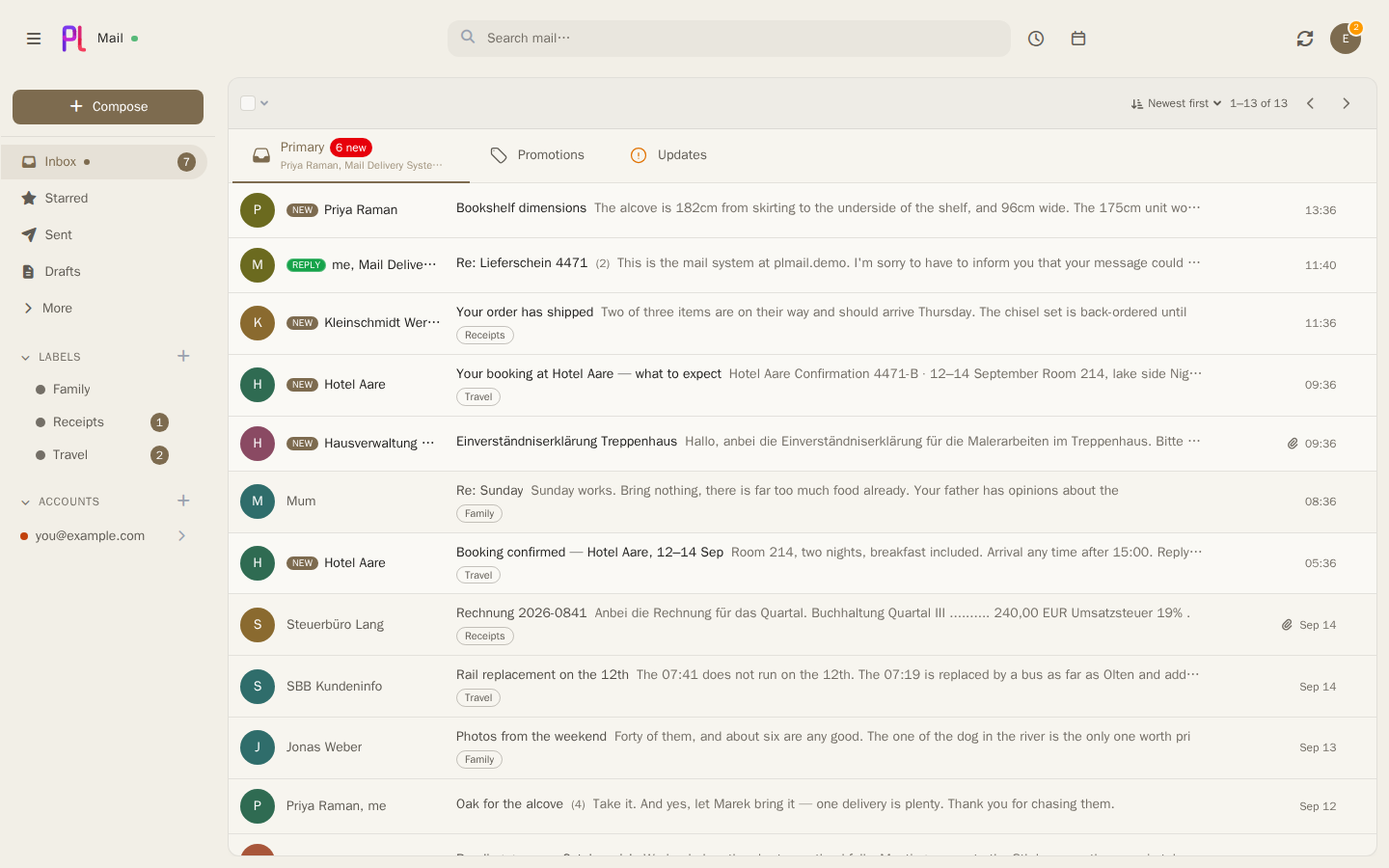
The sidebar, and what the lists mean
The left-hand rail is organised around labels rather than folders, because one label spans every account you have connected. Clicking Inbox shows the inbox of all of them at once; clicking a label you made shows everything carrying it, wherever it arrived.
| Entry | What it lists |
|---|---|
| Inbox | Everything still in the inbox, across every account, newest conversation first |
| Starred | Conversations with at least one starred message |
| Snoozed | Conversations waiting for their wake time |
| Sent, Drafts, Trash | The corresponding system label, across accounts |
| Archive | Hidden by default — switch the Archive label visible in Settings → Labels to get it |
| Accounts | One row per account; clicking it opens that account's inbox |
Clicking an account opens its inbox — the same question the top-level Inbox asks, about one mailbox instead of all of them. Its Sent, Drafts, Spam and Trash are folder rows underneath it, one click further; the account row is not an archive of everything the account has ever held.
Under Accounts, expanding an account shows the labels that actually exist on it. That list is narrower than the sidebar's own label list on purpose: the sidebar means "across every account", and the per-account list answers "what does this mailbox actually have". Which account you left expanded is remembered on the server rather than in the browser, so the sidebar renders already expanded instead of blinking open after the page has drawn.
The Labels and Accounts headings fold away. Collapsing one is remembered against your account rather than the browser, so it follows you to your phone, and it is rendered already folded rather than opening and snapping shut a moment after the page draws. What folds is the whole section — a wall of labels is what pushes the accounts off the bottom of a short window — though a nested label tree still collapses on its own for anyone who nests them.
An unread badge is a link. Clicking one opens that same view with everything already read filtered out — the inbox, Starred, Archive, Spam, Snoozed, or a label, under one account or across all of them — so the number on the pill is the number of rows you land on. That is the point of it being a count of conversations rather than of unread messages: a conversation holding three unread replies is one row, and a badge you click has to say how many rows it will give you.
While a list is narrowed it says Unread only, with Show all beside it, because a filtered list and a genuinely quiet one look identical otherwise. Everything else about the view survives the filter — the account it was narrowed to, the sort order, the tab — so Show all puts you back where you were rather than somewhere adjacent.
Trash and Drafts are not links, and neither is the Labels roll-up. The first two carry a total rather than an unread count, so there is no unread question being asked there; the roll-up stands in for several lists at once and has no single one to open.
A collapsed Labels heading carries the unread hidden underneath it, as a count of conversations. It is deliberately not the sum of the per-label numbers: a conversation filed under two labels would be counted twice, and the heading would promise more than expanding it could show. Accounts gets no such number, because there is no honest one to give — those counts are per account, and only the account you have expanded is loaded.
Every list pages at fifty conversations. Newer and Older in the toolbar move between pages.
Tabs
The inbox is split into the five Gmail categories — Primary, Social, Promotions,
Updates and Forums. For a Gmail account plMail trusts Gmail's own CATEGORY_* labels.
For everything else it works the category out from headers that were already stored, which is why
re-categorisation never needs a resync.
Choosing what sorts your mail
Both of those defaults are yours to change, under Settings → General → What sorts your mail.
Sorted by picks what decides. Rules reads headers — a mailing-list header, an unsubscribe link, a sender you have written to before — and answers the same way every time for the same message, without asking a model anything. The assistant has the model read each message and decide what it is for: better at mail that does not announce itself, and occasionally confidently wrong. Anything the assistant has not reached yet falls back to the rules, so a tab fills in as it works rather than being wrong until it does. The assistant option needs mail sorting switched on for the installation and for you, and says so when it is not.
One thing the assistant never overrules: a sender you correspond with stays in Primary. That rule is not a guess about the mail, it is a fact about you, and a model above it would file a colleague under Promotions on one bad afternoon.
It has one limit, and it is there because the rule was too generous without it. Mail that is plainly
a mailing — it carries an unsubscribe link, a mailing-list id, or says outright that it is bulk —
is sorted as one even when you have written to the address it came from. Otherwise a single enquiry
to a shop's info@ about a broken part pins every sale that shop ever sends into Primary, for ever.
A person you correspond with does not send you mail with an unsubscribe link in it; their marketing
platform does, from the same address.
On Gmail accounts decides whether any of that is allowed to disagree with Google. The default keeps Google's categories, because they are already there and two systems sorting one mailbox is worse than either — but if Google sorts your mail in a way you have never liked, this is the switch that lets plMail answer for itself.
Changing either one re-files the mail you already have. It happens in the background — a large mailbox takes a few minutes, so give the tabs a moment to settle — and it costs nothing outside plMail: the category is worked out from data already stored on each message, so nothing is re-downloaded and no model is asked anything. Conversations you moved to a tab by hand are left exactly where you put them.
(app:backfill category still exists and does the same work for every mailbox at once, which is
what an administrator wants after changing the rules themselves.)
Sort recent mail again is a different button, and only appears when the assistant is available. The assistant answers once per message, when it arrives, and keeps the answer — right, because the message does not change. What changes is the question: the prompt is editable, the model is a setting, and what plMail sends the model alongside a message changes between releases. This asks again about your newest 100, 200 or 500 messages.
It is bounded because it costs a model call each — a few hundred is minutes on a warm host, a whole mailbox is hours. Recent mail is where a wrong tab gets noticed anyway. Nothing asks again on its own, and nothing should.
Telling plMail it got one wrong
Open a message's to … dropdown and the bottom row asks whether it is in the wrong tab. Pick where it belongs and press Report. Nothing moves — this is not a way to file a message by hand, which is what dragging a conversation onto a tab is for — it records the DECISION so somebody can work out what needs changing.
What is kept is the evidence: what Gmail, the rules and the assistant each said, which bulk headers the message carries, who sent it and the subject. Not the body — it is the most sensitive part of a message and the least useful here, since most marketing mail has no plain-text part at all.
An administrator finds the collected reports in Admin → AI, with a button that copies them as text. That text is the point: it is what you hand to whoever is going to change a rule, the prompt or the model.
Watch it in the topbar. The run appears in the background-work indicator beside the search box, with a count as it goes and a note if it fails — the same place a "mark all read" over five thousand messages reports from. You can close the settings page; it carries on.
Upgrading from before 0.2: the assistant's verdict used to be consulted as a silent tie-break — used only where the rules found nothing, with no way to see it, prefer it, or switch it off. That is now what choosing The assistant means, and Rules means what it says. If you had mail sorting switched on and liked what it did, pick the assistant.
Each tab reads the way Gmail's do: an icon — filled in on the tab you are on — and, while a category holds mail you have never been shown, a "3 new" pill in that category's colour with a second line naming who that new mail is from, newest arrival first. That is deliberately the only number on a tab: unread already has the sidebar badge and the bold rows, so the tab keeps the one thing only it can say. The strip is live — pill and sender names update in place when mail arrives, without waiting for a reload, and a hint is retired the moment you look at its tab.
A tab holding unread mail also wears its category's colour on the icon. Not the tab you are on — its mail is already in the list underneath it, and the tint is there to point at what you cannot see. Still no second number: the colour says there is something here and the list header says how much.
It matters most under Unread only, where the strip is otherwise mute — every row on screen is unread, so boldness no longer separates anything, and the sidebar's Inbox badge is a single total that cannot name the tab its mail is sitting in. Without the colour a full tab looks exactly like an empty one and the only way to find the mail is to click each tab in turn. It is drawn on the ordinary inbox too, so the strip means the same thing wherever you meet it.
A conversation you have moved to the bin stops counting towards it, the same way it stops appearing in the list, so a coloured tab always opens on mail.
Open a message's Details panel to see why it is where it is. The first row is the tab the conversation is actually in; below it, what each of Gmail, the rules and the assistant said, with the one that decided marked — the three disagree more often than you would think, and seeing which one won is the difference between changing a setting and changing nothing.
Two things the panel will tell you that are easy to mistake for bugs. A conversation takes one category, from its newest message, so a reply can carry the whole thread out of the tab an earlier message belongs in; the panel says so when that has happened. And a category you set by dragging the conversation onto a tab holds against everything else, which the panel also says.
If it is simply wrong, Report at the bottom of the panel says where it should have gone. That goes to your administrator under Reported mail, with the three verdicts and the evidence behind them — which is what a rule or a prompt gets changed on the strength of. It sends the sender, the subject and the decision; it does not send the message.
The "New" marker
A conversation is new until its row has been shown to you. Not opened — shown. Scroll past something in the inbox and never click it and the badge goes, because you have stopped being surprised by it; the conversation is still unread, because you still have not read it. The two are different questions and plMail keeps both answers.
It shows as a filled New pill beside the sender on the row, as a "3 new" count pill on the inbox category tabs — the Gmail hint — and as a quiet dot, no number, on the sidebar's labels and roles and on Starred. Pill and dot both mean "something arrived here", which is what an unread count does not say.
Nothing stays new for longer than 24 hours after its last message, whether or not you ever saw the row. A marker you can only clear by looking at every row is a debt rather than a marker, so it expires on its own.
Search results retire the badge too: a row whose sender and subject you have just read in a result list has been shown, whichever list it was.
The radar
plMail reads certain facts out of mail as it arrives: parcel tracking numbers from shipping confirmations, flights from airline bookings and check-in mail, event tickets, issue and pull-request activity from GitHub notifications, one-time login codes, invoices with an amount and a due date, and subscriptions about to renew or trials about to run out. Each find becomes a small card. Dated ones queue up in the calendar's Happening Soon panel, under On your radar; a conversation that yielded something also shows its cards in a Found in this conversation strip above the messages.
A shop that never names a carrier still yields a parcel. Amazon states an order number and a link into its own tracker and no tracking number anywhere, so that is what the card carries — and a delivery day promised in words rather than digits ("arriving today", "Arriving Monday") is resolved against the mail's own arrival, never against the clock, so re-reading an old mail lands on the day it always did.
The strip above the mail list
Dated insights also appear as a band directly above the mail list — up to three of them, soonest first, each with what it is, when it is, and the one button worth having (Track package, or the thing on GitHub). It is the same set the radar panel holds, said where you already are: the panel answers "what is coming up?" for someone who went looking, the strip tells you a parcel is out for delivery when you did not.
The band updates itself. A sync that finds something new refreshes it in place, with no reload and no page you have to be on.
The ✕ on the band means "not now", not "never". Dismissing it hides the strip until an insight
it has never shown you is extracted — a parcel that ships tomorrow brings it back, while the one
you just waved away stays gone. Dismissing a single card through its ⋮ menu is the permanent
one, and when the last card goes the band goes with it. To be rid of it altogether there is a
switch under Settings → Insights; switching it off hides the band only — the facts are still
read, and still reach the radar panel and the conversation strip.
The band takes height and never width: no pane gives up a pixel for it, it is only fetched after the mail is on screen, and on the ordinary day when there is nothing to say it is not there at all.
Extraction is deterministic and local. It runs on your own server against sender domains, headers
and regular shapes — tracking numbers, flight codes, #123 — with no cloud service and no model:
nothing guesses, and a mail that matches no known shape simply yields nothing. That is a deliberate
trade — the radar would rather miss a parcel than invent one.
Every source has its own switch under Settings → Insights. Switching one off stops new cards from that source; what it already found stays until dismissed. The set of sources is extendable by design — an extractor added to a build lists itself on that settings page and starts running, without anything else changing.
New extractors do not re-read old mail on their own. app:backfill insights walks the mail already
in the database once and hands it to every enabled extractor, the same sweep the other backfill
tasks run.
One-time codes are the one source with an expiry rather than an occurrence. A code's card carries the moment the mail says the code stops working — "valid for 10 minutes", "gültig bis 09:30" — so it drops off the radar when it goes dead instead of sitting there looking usable. When the mail states no lifetime, the card carries no time at all: guessing ten minutes would either retire a code that still works or, worse, keep a dead one looking fresh.
Reporting a mail the radar missed
Because nothing guesses, a mail in a shape nobody has written a parser for yields nothing at all,
and it looks exactly like a mail with nothing in it. Report a missed insight, in a message's
⋮ menu, is how you say which of the two it was. A short dialog asks what plMail should have
spotted — "this is an invoice, due on the 3rd" — and files the report.
Reporting passes the mail on. The report carries a copy of the mail: sender, subject, arrival time and the first stretch of its text, along with your note. That copy lands in an area your administrator can read and download, and the dialog says so before you send it, because a parser can only be written from the shape of a real mail. Report the mail whose shape you want recognised, and not one whose contents you would not hand over.
Reporting the same mail again does not file a second report — it corrects the first, with your note as it stands ready to edit. What the administrator does with the pile is under Admin → Reported mail.
Threads
Replies collapse into one conversation, ordered oldest to newest with the latest message expanded. Each message has its own menu: Star, Archive, Mark as unread, Delete this message, Print, and Show original.
Show original reconstructs the message from the stored header map and the decoded body — no
raw RFC 822 blob is kept — and prints the SPF, DKIM and DMARC verdicts alongside it where the
provider recorded an Authentication-Results header. Both it and Print open in their own tab.
HTML bodies are rendered inline rather than in an iframe. Before that happens the body is put
through a sanitiser once, at ingest: cid: references are rewritten to plMail's own attachment
route, <style> blocks are flattened onto the elements they applied to, and scripts, forms,
iframes and classes are dropped. Links are forced to open away from the app.
Summarising a long conversation
Where the assistant is switched on — by an administrator, and by you in Settings → Assistant — a conversation of two or more messages carries a Summarise this conversation button at the right-hand end of its subject line. Nothing is summarised until you press it, and until you do there is no summary to look at: the card appears above the messages when you ask for one, and not before. A summary is the most expensive thing plMail asks of a model: expect around a minute the first time after a quiet spell, and around half that afterwards, with the text arriving a few words at a time so you can see it working. Stop ends it and keeps nothing.
The summary is written from the messages themselves and nothing else — not from your notes in Settings → Assistant, which are for how you want to be written for and have no business shaping a description of somebody else's mail. A German conversation gets a German summary.
When the conversation is too long to send whole
There is a limit on how much of a conversation goes to the model at once, and it is not plMail's choice: a model can only hold so much text at a time, and anything past that is dropped without a word — so a summary of a conversation that overran would quietly describe whichever end happened to survive. Rather than let that happen silently, plMail trims first and says that it did.
Two kinds of trimming, and the card names either:
- A long conversation is summarised from its opening and its most recent messages, and the middle is left out with a note saying how many messages it was.
- A single enormous message — a chain that has been forwarded and quoted a dozen times is one message, not a dozen — is cut short.
When either happens, the card says "This conversation was too long to send in full, so the summary was written from part of it", with Summarise the whole conversation instead underneath.
That second button does what it says: it sends everything and asks the model host to make room for it. Expect it to take noticeably longer — minutes rather than seconds on a long thread — and expect it to ask more of the machine running the model. Nothing is remembered, so it applies to the one summary you asked for and no others. If the conversation is so long that even this cannot hold it, you still get a summary, the note stays, and the button withdraws rather than inviting the same wait twice.
It runs in the background, and you do not have to wait for it. The card says it is queued and then you are free: close the conversation, go to another one, close the tab entirely. The summary is written by a worker and stored when it is finished, and it will be on the card the next time you open the thread — or it will appear there by itself if you are still looking at it.
That is not a convenience, it is the only way it works reliably. An ordinary summary is quick enough to watch arrive, so it streams. A full one is silent for minutes while the model reads, and a browser connection held open across that silence has a proxy, a network and a sleeping laptop in it — any of which can end it without telling anyone. Handing the work to a worker removes the dependency rather than trying to outlast it.
If the connection drops while it is being written, it is finished anyway. Reload the conversation and the summary is there. That covers a laptop closing, a network dropping and a reverse proxy giving up on a slow response — none of which plMail can see, and all of which used to throw the work away at whatever point they happened.
Once written, it is kept and shown the next time the conversation is opened, at no cost. If a reply arrives afterwards, the summary is shown greyed with a note that the conversation has changed and a button to write a new one — reading, starring or labelling the conversation does not do that, only the messages themselves changing.
It is a model's account of the mail, not the mail. The line under it says so, and the messages are directly below.
Labels
Labels are yours to create, from Create label in the sidebar or Settings → Labels. A label has a name, one of nine colours — gray, red, orange, amber, green, teal, blue, violet or pink — and optionally a parent, which is how nesting works. A label can be hidden from the sidebar without being deleted.
Creating a label does nothing at the provider. Gmail gets it the first time the label is actually applied to a message; plain IMAP never gets a folder created for it, because a folder only matters when a message physically moves. Mirroring structural changes — renames and deletions — outward is off unless you switch it on per account; see Accounts and aliases.
Deleting a label removes it from every account, and takes any nested labels with it. Messages are not deleted; they keep their other labels. You can delete one from the sidebar's own label dialog as well as from Settings → Labels, and the confirmation says plainly that the label goes from every account and how many nested labels are going with it — rather than asking you to agree to something whose reach it has not mentioned.
Search
The search box is at the top of every page and answers at /mail/search. Free text runs as a real
full-text query against Postgres — stemmed and ranked, not a substring scan — and combines with
any operators you type. Hostnames and addresses are indexed by their parts, so wirhub finds a mail
whose body only ever says help.wirhub.de.
| Operator | Takes | Matches |
|---|---|---|
from: |
a name or address | sender address or display name |
to: |
an address | the To list |
cc: |
an address | the Cc list |
subject: |
words | the subject line |
label: |
a label name | a label you made |
has:attachment |
— | also accepts has:attachments |
is:unread, is:read, is:starred |
— | read state and stars |
in: |
a mailbox name | see below |
after: |
a date | received on or after |
before: |
a date | received before |
in: accepts inbox, sent, drafts (or draft), trash (or deleted, or bin), junk (or
spam), archive (or archived) and snoozed. Quoted values are kept together, so
from:"Ada Lovelace" works.
Suggestions appear as you type, and so do actual results — the ten most recent matching conversations, under the operator suggestions, from about the third character. They are a preview rather than the answer: they run only the passes that are fast enough to spend on every keystroke, so a match that exists only as a fragment in the middle of a word in a long body will not be among them. Pressing Enter runs the complete search, which is where those live.
The preview steps aside entirely once your query carries an operator. It cannot honour is:unread
or label:, and ten unfiltered rows under a filtered query look exactly like ten honoured ones,
which would be worse than showing nothing.
Operators are completed from the list above; from:, to: and
cc: complete against your own harvested contacts, because remembering how a sender spells their
name is usually the reason you opened the search box. Enter takes the highlighted suggestion when
the list is open and submits otherwise, Tab takes it, arrow keys move through it, and the first
Escape dismisses the list while a second clears the box. The last eight searches are kept in the
browser and offered when the box is focused and empty.
An operator plMail cannot honour — is:important, in:nowhere, a date that is not a date —
becomes plain text rather than being dropped. That is deliberate: a dropped filter is a filter you
asked for and did not get, and the result would be a page of everything that reads as though the
search had been ignored. As free text it finds little or nothing, which is at least the truth.
A query that is nothing but a half-typed operator — from: with no value — returns an empty page
rather than the whole mailbox.
Results are Most recent first. The switch beside the pagination changes that to Most relevant, which is full-text rank — the best match leads, whenever it arrived. Whichever you pick is remembered for your next search, and paging keeps it. Switching orders starts again at the first page, because page four of one order is page four of nothing in the other.
Searching by meaning
If an administrator has switched Search by meaning on, one more pass runs beside the words: your query is turned into a vector and compared against the mail that has been indexed. It only ever adds results — the ordinary search is unchanged, and nothing it finds displaces anything the words found.
Rows it brought in on its own carry a small meaning badge. That badge is the answer to "why is this in my results when it does not contain what I typed" — a row the words found is never badged, even when the meaning pass would have found it too.
Under the box, one quiet line says what that pass actually did, and it is worth reading before judging the results:
| What it says | What it means |
|---|---|
| Searching meaning across 4,120 of 48,900 messages — 8% complete | The index is still being built. Anything it has not reached cannot be found by meaning yet, so the answer will get better on its own. |
| The search model changed… | Every vector stored before the change belongs to a different model and cannot be compared with the new one. Nothing is searched by meaning until the mailbox has been indexed again. |
| The model took too long… / the model host did not answer… / does not have the search model… / no model host is set up… | The pass never got a vector, and the sentence names which of those it was. All four are about the model host; the search itself was never asked to run. |
| Searching by meaning took too long here… | The vector arrived, and the database gave up scoring it inside its five-second budget. Nothing is wrong with the model host — this one is about the mailbox being larger or the machine busier than the budget allows. |
| Searching by meaning could not be completed… | The scoring query failed outright rather than running out of time, so it will fail on every search until somebody looks. The reason is in the server log, at error level, with its SQLSTATE. |
| …so this search used words only (any of the above) | Whatever the reason, your results are the ordinary search, complete and correct. Only the extra pass is missing. |
| found nothing the words had not already | It ran, over a finished index, and had nothing to add. |
The difference between the first and the last is the one that matters: "not yet" and "there was nothing" produce the same list and mean opposite things. Nothing is said at all while the feature is switched off, because then the ordinary search is not missing anything.
Building that index is one pass over the mailbox and an administrator starts it — see Administration.
Search only covers mail that has been synced. plMail syncs everything an account holds and there is no setting that bounds it, so a large mailbox is searchable in full a few sync runs after it is added rather than immediately; see Accounts and aliases.
Acting on mail
Row buttons and the toolbar do the same things, the toolbar over everything selected. Select all has a menu beside it offering All, None, Read, Unread and Starred.
Star, Archive, Delete, Label as, Mark as read / Mark as unread and Snooze all apply to a whole conversation or to a single message, and all of them travel outward to the provider as well as changing what you see here. Archiving is modelled as removing the Inbox label and nothing else — where the message lands afterwards is the provider's business.
Refresh in the toolbar queues a sync for every active account you own and spins until those jobs have drained.
Snooze
Snoozing is archiving with a timer. The conversation leaves the Inbox now — at the provider too, not only in plMail's view of it — gains the Snoozed label, and comes back when its time is up.
The menu offers Later today, Tomorrow, This weekend, Next week, Pick a date and time, and Unsnooze on something already snoozed. Later today is 18:00 and is offered only while that is still ahead; the other three land at 08:00 on the next day, the coming Saturday and the coming Monday. All four are computed in your browser, because the server never sees a timezone for the session and would otherwise resolve "tomorrow morning" to wherever the container thinks it is.
app:mail:wake-snoozed runs every minute and is what brings conversations back. A woken
conversation is marked unread — that is the point of the feature, since a thread returning in
the state you left it in is one you have already learned to scroll past. The read state it had is
genuinely lost.
The Snoozed list is ordered by the conversation's last message, like every other list, rather than by wake time.
Attachments
Attachments show as chips under the message, with a preview for images. Clicking one downloads it; only images are ever served inline, so email-supplied HTML can never run on plMail's own origin.
A PDF opens in a reader instead of downloading — pages, zoom, and the download button still there in the toolbar. The document is drawn by plMail's own code in your browser rather than handed to the browser's PDF plugin, which is what keeps the rule above intact: the file is still served as an attachment, and nothing in it gets to run on plMail's origin. Nothing is sent anywhere to make this work; the reading happens on your machine.
Signing a PDF
Sign in the reader's toolbar opens a pad. Draw your signature with a mouse, a trackpad or a finger, press Place on page, and drag it where it belongs — the corner handle resizes it. Then either Reply with signed copy, which opens a reply with the signed file already attached, or Download signed copy.
Two things are worth being plain about.
This is a visual signature. It is a picture of your name drawn onto the page, exactly as if you had printed the document, signed it and scanned it back in — and it is worth precisely as much as that is. It is not a digital signature in the cryptographic sense: there is no certificate, nothing is registered anywhere, and it does not prove the document was unaltered afterwards. If you have been asked for a qualified electronic signature, this is not it.
The document never leaves your browser to be signed. The stamping happens on your machine, and plMail's server only sees the result if you choose to reply with it. Nothing is uploaded to a signing service, because there is no signing service.
Save it once instead of drawing it every time. Settings → Profile has a pad beside your picture; draw your signature there and the reader gains a Use saved signature button that places it without asking you to draw again. It is stored as an image belonging to you, served only to you, and you can remove it from the same place. It changes nothing about what the signature means — it is the same picture of a name either way.
A PDF that is password-protected cannot be signed here — the reader says so, and reading it still works. Editing one would mean stripping the protection it was given, which is not a decision plMail should make quietly on your behalf.
Save to on an attachment pushes it out to a connected service — see Files and integrations. This works for Gmail and Microsoft messages whose attachment has never touched plMail's disk; it is materialised on first access.
Composing
Compose opens a window docked at the bottom right. Replying from inside a thread opens the editor at the foot of the conversation instead, on a wide screen; below that it falls back to the dock. Either way the window offers rich text, contact autocomplete on the address fields, and a From selector listing every active account and every sending alias on it.
Autocomplete only ever offers your own harvested contacts. On an install with more than one person, nobody's correspondents are visible to anybody else, and an address belonging to another account cannot be put on your draft by any route.
Attach files takes files from your machine, capped at 25 MB per file. Attach from a service opens the file picker for any connected service plMail can download from.
Drafts save themselves two seconds after you stop typing, and a draft is created once there are at least five characters of body or a subject — a subject typed on its own is worth keeping. Closing the window, popping it out, or attaching a file all force a save first. Below that threshold, leaving the page interrupts rather than losing what you typed. The trash button in the compose window genuinely deletes the draft rather than closing the window on top of it.
On a phone the toolbar wraps rather than scrolling out of reach, and the send pill moves up into the window's header, where the old button used to be.
Emoji
The smiley opens the full Unicode set, with categories, search, skin tones and the ones you have used recently. Picking one inserts it where the caret was.
It only ever inserts on a pick. Typing :) or :smile: leaves :) and :smile: in the
message, byte for byte — plMail does not rewrite what you type into pictures.
Search is in the language the window is in, because the emoji data is shipped per locale rather than fetched. Both the data and the colour emoji font are served by plMail itself; nothing is loaded from a CDN at runtime, so the picker works on an install with no outbound internet access at all.
Images in the message
The image button, a paste, and a drag-and-drop onto the editor all do the same thing: the picture goes into the body, where you placed it, rather than beside the message as an attachment. Same 25 MB ceiling as an attachment, and only images — anything else is refused with a reason on the status line.
Inline images travel as cid: parts of the message, which is what every mail client can resolve, so
the recipient sees the picture rather than a broken link back into plMail. They are not attachments
and are not counted as any: a message whose only picture is one you placed in the body carries no
paperclip.
Links
The link button opens a small panel with a URL field and a text field, the text prefilled
from whatever you had selected. A bare example.com is understood and stored as https:// — it is
not a path inside plMail. Only web, mail and telephone addresses can be linked; anything else is
refused there and then rather than being quietly dropped when the draft saves.
Clicking a link already in the editor shows the panel's other face: the address, and Open, Change and Remove. It dismisses on Escape, on a click outside, and as soon as the caret moves off the link.
Signature
Signatures live in Settings → Signatures. Each account has one, and any of its sending addresses can override it. Three states matter, and they are not the same:
| State | What that address signs with |
|---|---|
| Inherits | The account's signature. This is what an address does until you say otherwise. |
| Its own | Whatever you wrote for that address, instead of the account's. |
| Deliberately nothing | Its own signature, left empty. The address signs with nothing even though the account has one. |
The last two are both "an override"; the difference is whether the override is empty. That is why an empty box is not read as "inherit" — a personal alias that signs with nothing on a work mailbox that signs with a block is the whole reason the setting exists.
In the compose window the signature is inserted for you, above the quoted text, on a new message and a reply, with an empty paragraph in front of it so the caret starts in the writing space rather than inside the sign-off. A forward is deliberately unsigned — its content is the mail being passed on, and the caret starts in the To row, since the recipient is the one thing a forward cannot leave without; Insert signature adds the block when you want it. That button replaces the block in place instead of adding a second one, and so does changing the From account: the signature block is swapped and a paragraph you have already typed survives the change.
Writing inside a conversation gets a reduced header: the To field itself, typable, with From, Cc, Bcc and the subject folded away behind the chevron beside it. Replying rarely means retargeting — but forwarding always does, and the recipient is the one thing a forward is missing, so the field is the first thing under the caret rather than a line of text describing it.
A forward opens with the original folded behind the show quoted text pill. If you would rather see it spread out from the start, Settings → General → Composing has the switch — folded stays the default, and either way the quote counts as the message's content: sending a forward without a word of your own above it is not questioned as an empty mail.
Scheduled send
The chevron beside Send opens Send later: Tomorrow morning (08:00), Tomorrow afternoon (13:00), Monday morning, and Pick date & time for anything else. Tomorrow-is-Monday drops the third, because a menu offering one instant under two names is a menu you have to check.
Every time is read on your clock — the timezone and the 12-or-24-hour format from Settings → General, not the browser's — and the menu says which zone it means. A laptop still on another continent's time does not move your morning.
The floor is one minute: below that, "schedule" is "send" with a worse undo, and the picker refuses it in the window without a round trip. The ceiling is 30 days, the same limit JMAP clients are told about, so the web window and a phone cannot disagree about what was allowed.
A scheduled message is a draft that is being held. It says so on its row in Drafts and on the draft's row inside a thread — Scheduled … — and Cancel scheduled send is on that row's menu. The toast has faded long before anybody goes looking, which is the point of putting it there. A cancel is visible on every other device too, not just the one that made it.
More options
More options — the ⋮ beside the toolbar — carries the three things that change what the message is rather than how it looks:
- Priority — No priority, Low, Normal or High. "No priority" is distinct from "Normal": an untouched message says nothing about its urgency and carries no priority headers at all.
- Request read receipt — see below.
- Plain text mode — drops the formatting and sends a plain-text message. It warns first, and only when there is formatting to lose. It is reversible while the window is open; once the draft has been saved as plain text the formatting is gone for good.
Encrypt sits in the same menu, disabled, and says why: there is no encryption yet. It is named rather than hidden because a lock icon that does nothing is the one lie a mail client must not tell.
Read receipts
A read receipt is a message that goes back to the sender saying their mail was displayed. plMail does both directions, and the receiving direction is the one worth reading carefully — it is a privacy setting, not a convenience.
Asking for one
Request read receipt in the compose window's more-options menu. The request names the address you are sending from, alias included, rather than the account: a receipt has to come back to the address that asked, or nothing on the way in can match it to the message.
When one comes back, the message in Sent gains Read at …. The receipt itself is marked read and taken off the Inbox rather than being deleted, so it is there if you want it and not in your way if you do not.
Being asked for one
Settings → Aliases → Compose defaults, per address. Three modes:
| Mode | What your mailbox does |
|---|---|
| Never send | Nothing is sent, and the sender is told nothing. This is the default. |
| Ask each time | The message shows … asked to be told when you read this message, with Send receipt and No thanks. |
| Always send | A receipt goes automatically when you mark the message read. |
Never is the default and stays the default until you change it, deliberately. A receipt confirms that a specific address is live, is monitored, and was reading at a specific minute — which is exactly what somebody fishing for that gets by setting one header. Someone who never opens this setting emits nothing.
Two things narrow it further, both in the same direction:
- A receipt is only ever sent when you mark a message read yourself. A sync discovering that the message was already read in another client sends nothing: a receipt claims a person displayed the message, and a sync pass learning about last Tuesday cannot make that claim.
- A request pointing somewhere other than the sender is downgraded to "ask", however the address is set. If the return address disagrees with who the mail came from, plMail will not answer it automatically — it asks you, and says what the mismatch was. Not silence, because the legitimate version of that shape is a bulk sender collecting at its bounce address.
When mail does not arrive
A message that is refused comes back as a delivery status notification — a machine-generated
mail from MAILER-DAEMON whose body is an SMTP transcript. On its own that is easy to miss and hard
to read, and the message it is about goes on sitting in Sent looking like it worked.
plMail attaches the report to the message it concerns. The failed message gains a red Not delivered panel naming the recipient that failed, the reporting server's own words, and the time and status code:
Not delivered to versand@nordwind-logistik.exmaple. smtp; 550 5.4.4 [Host not found] the domain nordwind-logistik.exmaple does not exist 26 Aug, 14:12 · 5.4.4
Three things it deliberately does not do:
- The bounce is not filed away. Unlike a read receipt, it stays unread in the Inbox. Its body is frequently the only readable statement of what went wrong, and a failure you may have to act on is not something to tidy up on your behalf.
- Nothing is retried and no address is disabled. plMail records what one server said about one attempt. Whether the address was a typo, a mailbox that is full, or a server having a bad morning is not something it can tell from the report — so it shows you the report and leaves the decision where it belongs.
- A delay notice is not a bounce. Mail servers send one of these after a few hours and keep trying for days. A message still in flight is not marked as failed, because the panel would then be wrong at exactly the moment it mattered and nothing would clear it when the mail went through.
A bounce for a message this mailbox never sent — which arrives constantly, as forged mail bounces back at the address it was forged from — is ignored. The report has to name a message you actually sent before anything is attached to anything.
Undo send
Pressing send queues the message with a ten-second delay and leaves the composer exactly where it is. The Send button becomes the way back: it reads Sending… with click to cancel under it, and a second click on that same button calls the send off. That is the only cancel there is — no toast, no bar at the foot of the thread — and it works the same in the floating composer and in a reply written inside a conversation.
While the send is out the message itself is out of reach: the window is showing a copy of mail that has left, so the fields are frozen rather than editable. When the window expires the composer closes on its own, a Message sent toast confirms it, and the message takes its place in the conversation — unless it was a forward, which starts a conversation of its own and is therefore found in Sent rather than under the mail it was forwarded from.
Cancelling says nothing. The draft coming back with everything in it — recipients, subject, body, attachments — is the confirmation, and it is the same in both composers.
Undo does not race the mail out of the door in the sense that matters: the cancellation and the send job settle it between them in one step, so the database decides who won and only one of them proceeds. Win, and the message goes back to being the draft it was, with the editor reopened where it was.
Lose — press Undo in the last moments, after the job has already claimed the message — and you are told so plainly: Too late — that message had already been sent. You are not handed an editable copy of mail that has gone out. Because the window offered is eight seconds against a ten-second hold, losing is rare rather than routine.
Where to read further
- Mail ingest — the pipeline from provider to database, threading and categorisation.
- Accounts and aliases — connecting mailboxes, instant delivery, sending addresses.
- Account health — when mail stops arriving, and the repair that keeps the mailbox.
- Filters — sorting mail as it arrives, and applying a rule to mail you already have.
- JMAP — the same operations as a client sees them.
Things that bite
The cancel disappears two seconds before the message does. The send job is held for ten seconds, but the composer stops offering click to cancel after eight and closes itself. Nothing is wrong when a message goes out after the window has gone — the offer really did expire.
Closing the composer during those seconds does not stop the send. The Send button is the cancel; the close button is still just a close. Shut the window, or the tab, and the mail goes.
An Undo can lose, and losing is told to you. Click the cancel at the very edge of the window and the answer may be Too late — that message had already been sent. That is the honest outcome rather than a failure: the alternative would be handing back an editable draft of mail that is already on its way, which reads as a cancellation that worked.
A thin result from a search by meaning is usually an index that is not finished. The line under the search box says how far it has got, and until it says nothing at all, "meaning found nothing" is "meaning has not got there yet". It is not the feature's verdict on your mail.
Deleting a label from the sidebar is the same delete as the one in settings. It is not a "remove from this view" — the dialog is a shortcut to the same operation, across every account, nested labels included.
A signature image cannot be an inline image. A picture placed in a signature is stored as an
ordinary image reference, not as a cid: part: the sanitiser every signature is written through
drops the marker attribute that would make it one, deliberately, so a signature cannot smuggle in
something that looks like one of the message's own inline pictures. Inline images work in the
message body, where you put them.
"New" is not "unread", and losing the badge is not reading anything. Scrolling past a row in the inbox retires its New badge, because the row was put in front of you. The conversation stays unread until you open it. A thread that is unread and not new is the normal state of everything you have been meaning to get to.
A New badge you never saw expires anyway. Nothing is new for longer than 24 hours after its last message. Coming back from a fortnight away means an inbox with no New badges at all — that is the marker working, not a marker that failed to appear.
Plain-text mode is only reversible until the draft is saved. The warning says so before the switch. Once the draft has been stored as plain text there is no formatting left anywhere to come back to.
A scheduled send cannot be closer than a minute away. Typing the next whole minute is exactly the time a person picks to try the feature, and it is refused — with a reason, in the window, without a round trip. Anything from a minute to thirty days out is accepted.
Waking a snoozed conversation marks it unread, and the old read state is gone. This is chosen, not accidental, but it does mean snoozing a thread you had read leaves you with an unread thread afterwards.
A snooze time in the past is accepted. It means the next sweep, a minute later, brings the conversation straight back. That is a harmless way to say "bring this back now", not an error.
Deleting a label deletes it everywhere. The sidebar's label list is cross-account, so the
delete is too — including nested labels underneath it. A JMAP client's Mailbox/set destroy is the
per-account operation; the web UI has no equivalent.
Search only covers mail that has arrived. plMail syncs everything an account holds, but a large mailbox takes several runs to come across in full, and mail that is not in yet is not searchable however certain you are that it exists. Give it time rather than a setting.
An oversized attachment can fail with no per-file reason. PHP discards the whole request body
when it exceeds post_max_size, so nothing arrives to report an error about. plMail answers
"Upload too large" for the whole upload rather than staying silent, but it cannot tell you which
file caused it.
Marking a message read in another client does not come back. Flag changes travel outward only; incoming IMAP flag sync over the IDLE stream is not implemented.
Reporting a mail hands over a copy of it. Report a missed insight is not a vote or a thumbs-down: it stores the sender, the subject and the beginning of the message text where an administrator can read and download it. That is what makes a new extractor writable, and it is why the dialog says so before you send. On an installation you do not run yourself, report the mail whose shape you want recognised — not one whose contents you would rather keep.
A one-time code with no stated lifetime gets no expiry. The card shows the code and no time, and it stays until you dismiss it. plMail will not invent ten minutes, so the card cannot tell you whether the code still works — the mail it came from is the only thing that can.