



📖 Read the handbook →
Installing on Docker, Linux, WSL2, macOS or a NAS · every feature in detail · connecting Gmail and
Outlook, with the exact permissions to tick · how the internals work.
Also on the wiki and in docs/ — all three
are built from the same files.
What it is
A mail client you host yourself. It connects to the mailboxes you already have — IMAP, Gmail, Outlook — syncs them into your own PostgreSQL database, and gives them one inbox, one search box and one set of labels in the browser.
It is not a mail server: it doesn't receive mail from the internet or host your domain. Because everything is synced locally, search runs against your database, and your mail stays readable when a provider doesn't.
Highlights
- Every account in one place — IMAP, Gmail and Outlook side by side, sending aliases included. Credentials are encrypted before they touch the database.
- New mail arrives on its own — IMAP IDLE, Gmail and Outlook push, browser notifications.
- Search that means it — full text plus
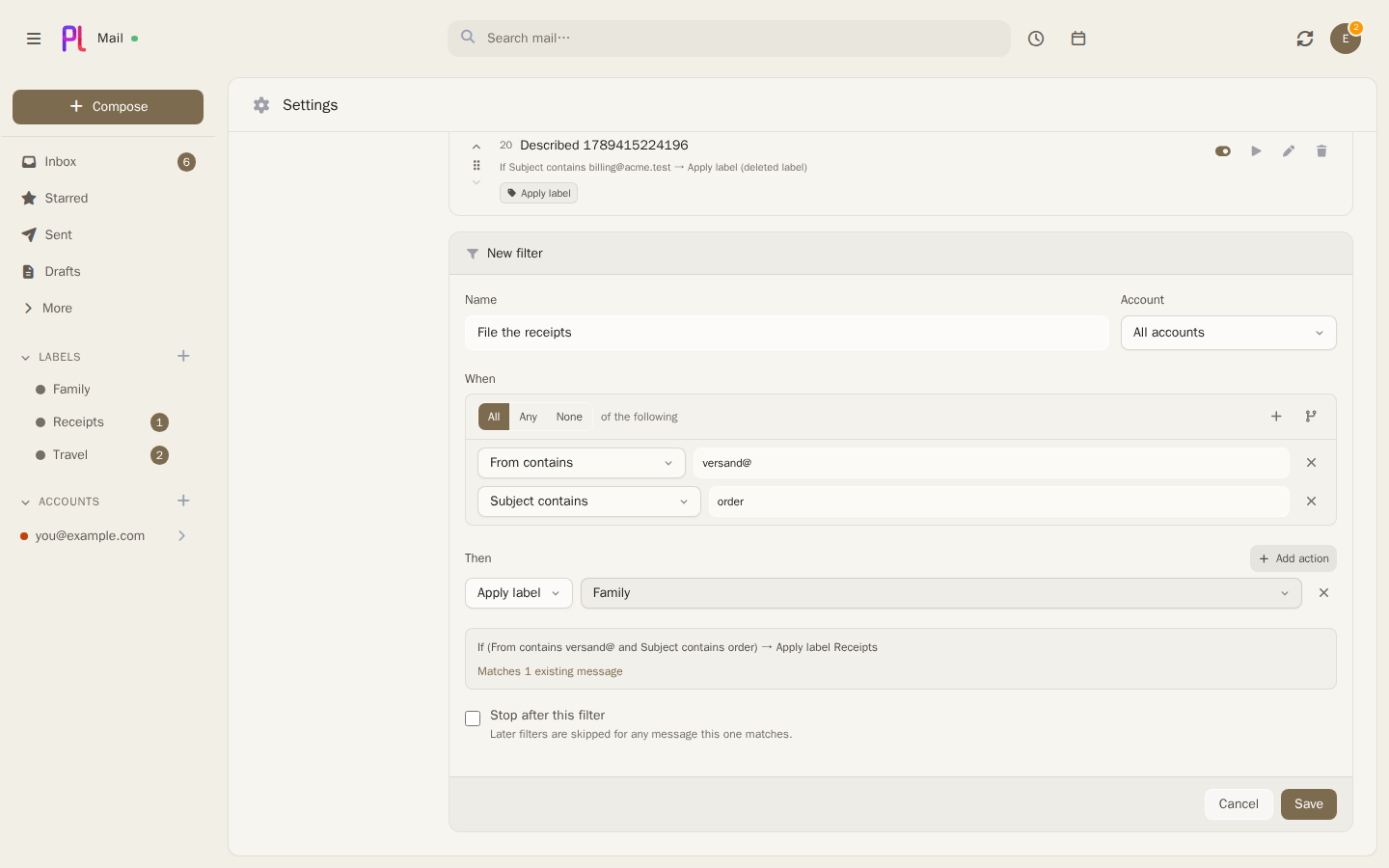
from:,subject:,label:,has:,before:and friends, completed as you type. - Filters as a tree — any/all/none, nested, restated in plain English and counted against real mail before you save. Apply one to mail that arrived before it existed.
- Filed where you drop it — drag a conversation onto a folder, a label or one of the inbox tabs, several at once if they are ticked. A folder moves it and a label just adds itself, so dropping on "Receipts" does not take the mail out of your inbox. Only the targets that will accept it light up, and a tab you choose by hand stays chosen when the next message in the thread arrives.
- A calendar beside the mail — two-way sync with Google, Microsoft and CalDAV, a drag-to-move week grid that pans rather than squeezes on a phone, invitations answered in place, share and booking links.
- Files where you keep them — attach from and save to Drive, Photos, OneDrive, Dropbox, Nextcloud, Immich and Paperless-ngx.
- A language model, if you want one — point plMail at an Ollama box on your own network and it can search by meaning, draft replies, summarise a thread and sort mail into tabs. A long thread is summarised from as much of it as fits, and says so; ask for the whole conversation and it runs as a job with a context window to match. What it has been told about how you write is editable in the composer, for one attempt at a time. Off by default, each of the four switched on separately, and nothing ever leaves your network.
- You decide what sorts your mail — header rules that answer the same way every time, or the model reading each message; and on Gmail, whether either of them is allowed to disagree with Google. Change your mind and the mailbox re-sorts itself in the background. Every message's Details panel shows what all three said and which one won, and a Report button tells your administrator when it got it wrong.
- It tells you when something breaks — a sign-in that has expired, a calendar that stopped syncing, push that lapsed, work the queue gave up on. Each with what it means for your mail and the smallest thing that fixes it. A Google sign-in dying every week gets named for what it is — Google expires tokens for an app still in Testing — and warned about before the next one.
- Yours — two-factor auth, per-app JMAP passwords, 41 themes, English, German and Pirate.
A look around
 |
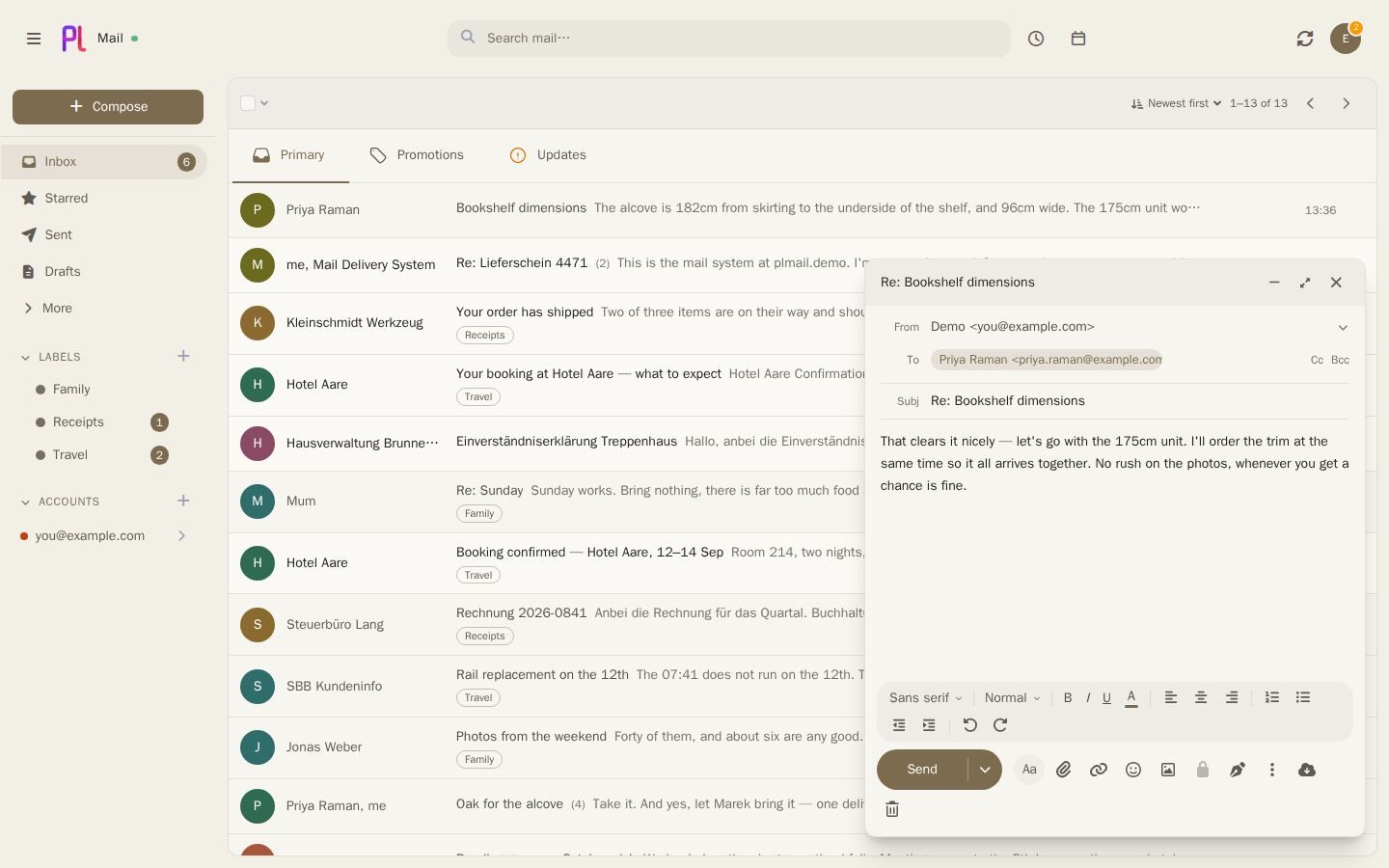 |
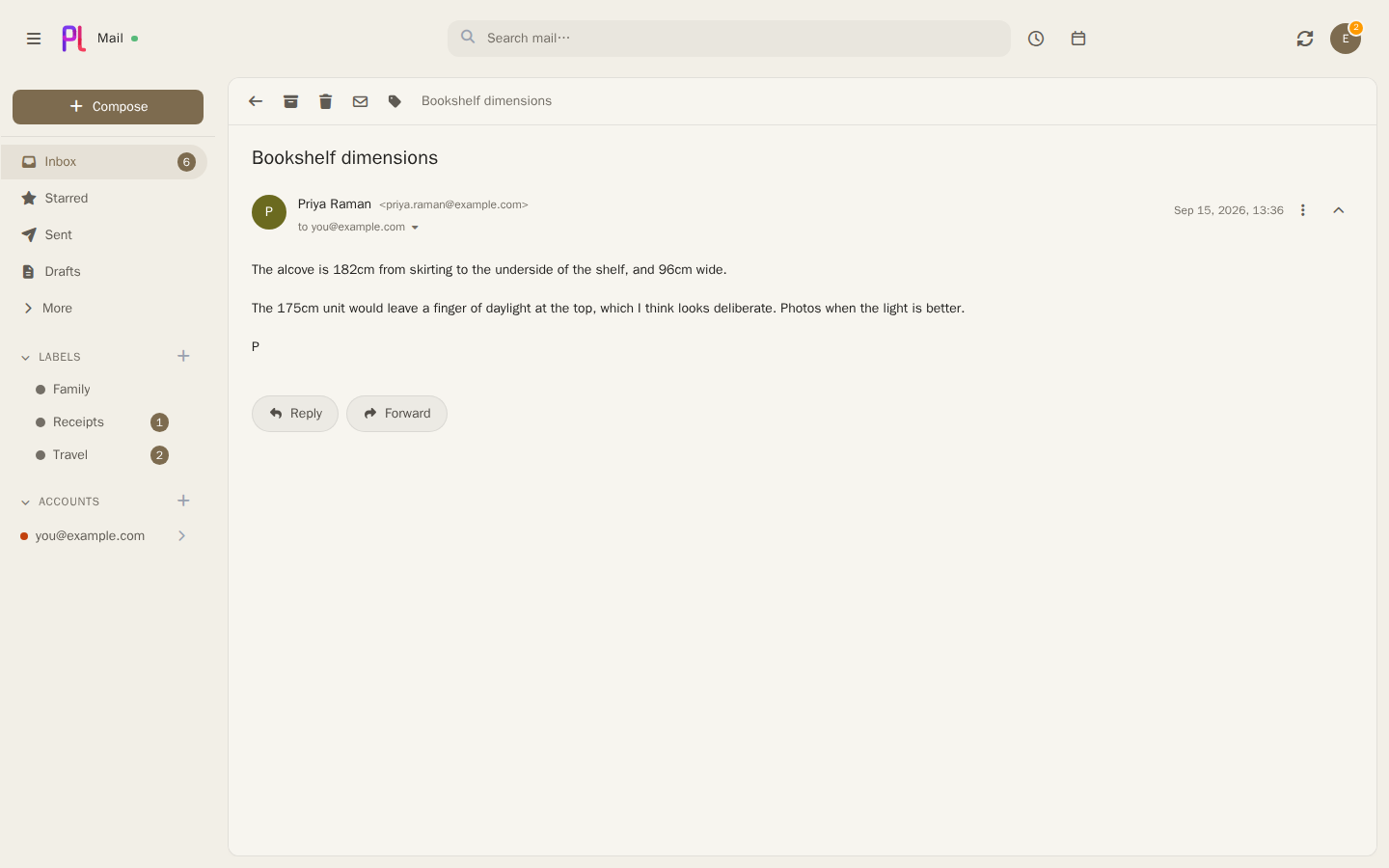
| Threads — replies collapse into one conversation. | Compose — rich text, autocomplete, undo send. |
 |
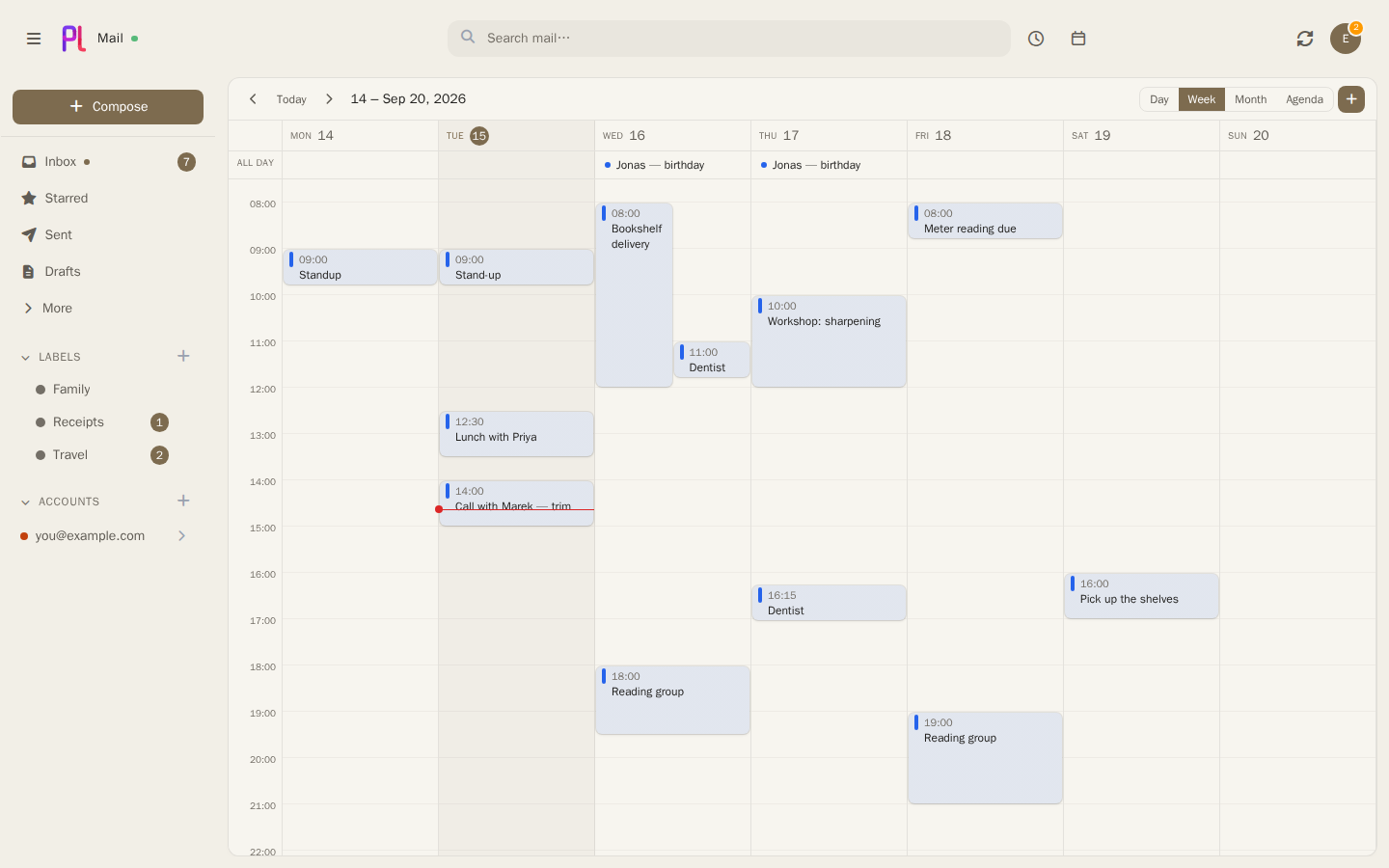 |
| Themes — 41 of them, light and dark. | Calendar — docked beside the mail, or its own page. |
 |
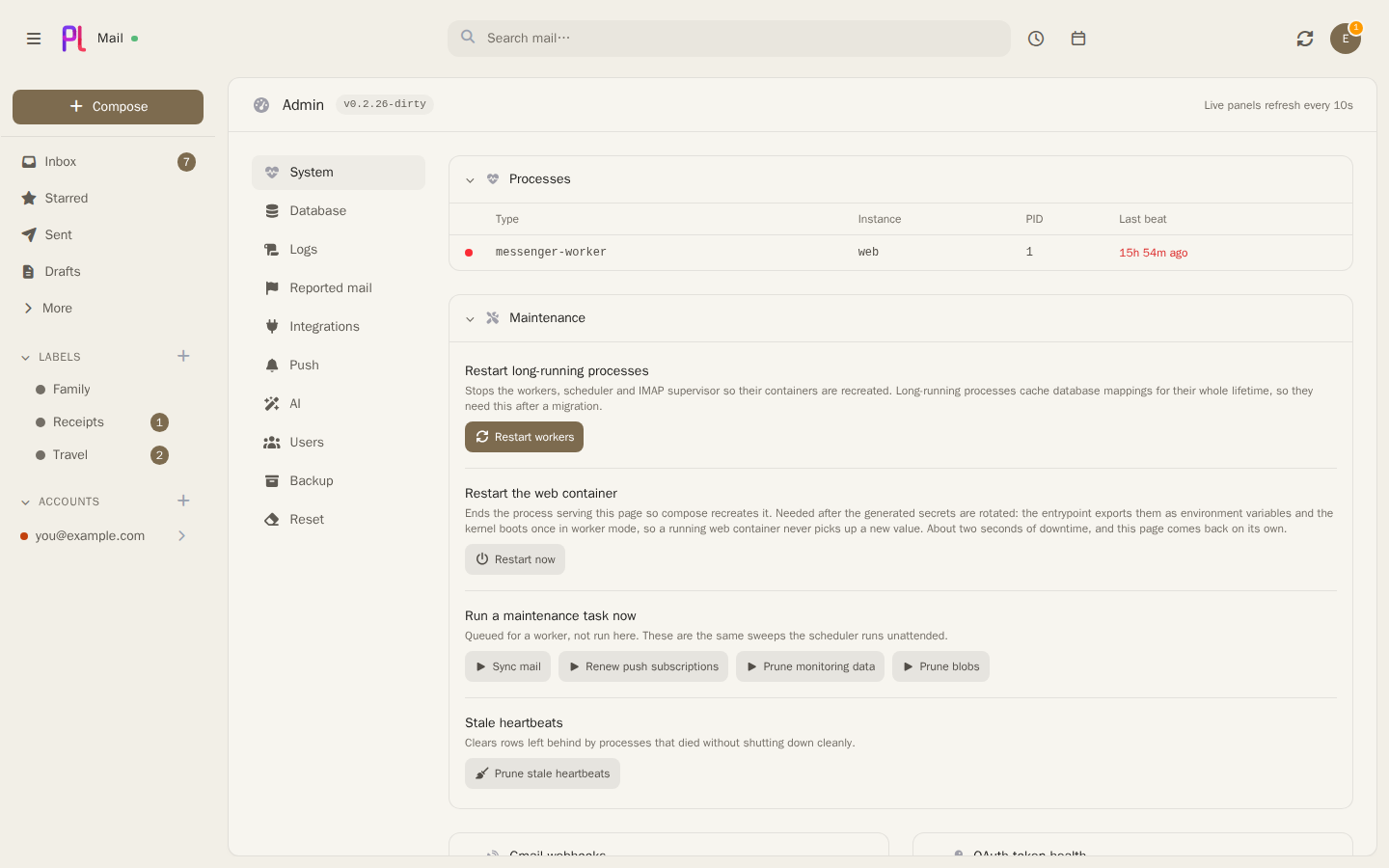 |
| Filters — counted before you save. | Admin — workers, push health, logs, queue. |
Screenshots use demo data — none of the accounts, senders or messages shown are real.
Install
Images are published for linux/amd64 and linux/arm64. Nothing to fill in first: the secrets are
generated on first start, and the public address is asked for on the setup screen.
Docker
git clone https://github.com/karatektus/pl_mail.git
cd pl_mail
docker compose up -d
Open https://localhost and create your account.
TrueNAS SCALE
- Create a dataset for plMail — say
yourPool/yourDataSet/plmail. - Open
truenas.compose.yamland change one line to that path:path_data: &path_data /mnt/yourPool/yourDataSet/plmail - Apps → Discover → ⋮ → Install via YAML, paste the file, install.
Reach it on port 30080 and put a reverse proxy in front of it. Everything else in that file works
as it is; each setting explains itself in place.
Then
Add an IMAP mailbox in Settings → Mail accounts and you're done. Gmail and Outlook need OAuth credentials from Google or Microsoft first — the handbook walks through both, including the optional Pub/Sub topic for instant Gmail delivery.
Back up two things, separately: the PostgreSQL data and
var/secrets/generated.env. The database holds your mail; the key inside that file unlocks the credentials in it. Keeping them apart is the point — and losing the key means the stored mailbox passwords are gone.
Contributing
Bug reports and pull requests welcome — see CONTRIBUTING.md for the dev setup, the test suites and the console commands.
License
AGPL-3.0.